Research
Quantum computing is linear algebra wearing a lab coat
Abstract. I joined Prof. Yuxi Hong's lab expecting physics and found, mostly, linear algebra with strong opinions about norms. This is a foundations write-up: qubits as unit vectors, gates as unitary matrices, entanglement as non-factorizability, measurement as the one genuinely non-linear step, and then the payoff that keeps me here — quantum amplitude estimation offers a quadratic speedup over classical Monte Carlo, which is the most interesting sentence anyone can say to someone who just spent a semester measuring Monte Carlo cache behavior.
Keywords: qubits, unitary operators, tensor products, Born rule, amplitude estimation, quantum finance.
1. The whole subject in one vector
A classical bit is in or . A qubit is a unit vector in :
The coefficients are complex, and that is not decoration — the phase is what allows interference, which is the entire source of quantum advantage. Strip the complex part and you have a classical probability distribution; keep it and amplitudes can cancel. You can park the state on the Bloch sphere,
and suddenly "quantum state" means "point on a sphere," which is the first moment the mysticism drains out of the subject. (Sutor's Dancing with Qubits [2] and Wong's Introduction to Quantum Computing [3] are the two books I am working through; Nielsen & Chuang [1] is the cathedral I visit when I need rigor.)
2. Gates are just unitary matrices
Every operation on a qubit, short of measurement, is a unitary matrix — one satisfying . That single constraint is the physics: it is exactly the condition that preserves total probability,
Geometrically, unitaries are the norm-preserving rotations of ; the columns of form an orthonormal basis, and that is the whole content of . The Pauli gates are the canonical examples:
and the Hadamard, , which manufactures superposition out of a basis state. is the quantum NOT. flips a phase. They all square to the identity, which is the kind of fact that makes you trust the framework.
3. Two qubits, and the part that is genuinely weird
Compose qubits with the tensor product: two qubits live in , with basis . Most states in that space cannot be written as a product of single-qubit states. The Bell state
is the standard example, and you can prove its non-factorizability in four lines of coefficient-matching. That non-factorizability is entanglement — measure one qubit and you instantly constrain the other, with no operation on it. It is the one place where the linear-algebra story stops feeling like ordinary linear algebra.
4. Measurement: the only non-linear step
Everything above is reversible and linear. Then you measure, and the Born rule collapses the state to outcome with probability
renormalizing afterward. That renormalization is non-linear — it depends on — and it is the seam where a quantum computation hands a classical answer back to you. Most of the engineering difficulty in the field lives at this seam.
5. Why a Monte Carlo person should care
Here is the sentence that recruited me. Classical Monte Carlo estimates an expectation (an option price, a risk number) with error that shrinks like
so halving the error costs four times the samples. Quantum amplitude estimation [5, 6] encodes the same expectation as an amplitude and extracts it with error
a genuine quadratic speedup.
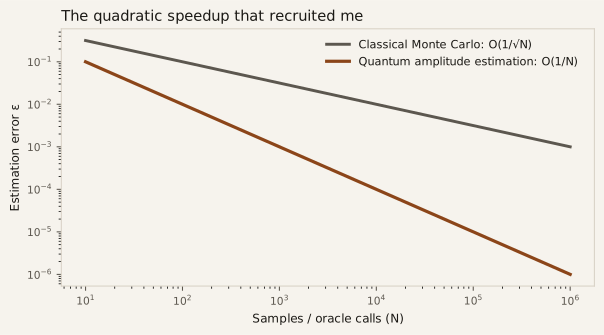
For derivatives pricing and value-at-risk, that is the difference between and "samples" for the same precision — if, and it is a load-bearing if, you can build the state-preparation circuit and you have the coherence budget to run it. On today's NISQ hardware [4] you mostly cannot, yet. But that gap is precisely the research direction: the same locality-and-budget discipline I learned measuring classical Monte Carlo cache behavior is the right instinct for husbanding the far scarcer coherence budget of a quantum device.
That is the bridge I am building in the Hong Lab — classical HPC Monte Carlo on one side, quantum amplitude estimation on the other, and the matrix algebra above as the common language. It turns out the linear algebra I took "for the math degree" was the quantum-computing prerequisite all along. The lab coat was optional.
References
- Nielsen, M. A., & Chuang, I. L. (2010). Quantum Computation and Quantum Information (10th Anniversary ed.). Cambridge University Press.
- Sutor, R. S. (2019). Dancing with Qubits. Packt.
- Wong, H. Y. (2022). Introduction to Quantum Computing: From a Layperson to a Programmer in 30 Steps. Springer.
- Preskill, J. (2018). Quantum Computing in the NISQ Era and Beyond. Quantum, 2, 79.
- Brassard, G., Høyer, P., Mosca, M., & Tapp, A. (2002). Quantum Amplitude Amplification and Estimation. Contemporary Mathematics, 305.
- Stamatopoulos, N., Egger, D. J., Sun, Y., Zoufal, C., Iten, R., Shen, N., & Woerner, S. (2020). Option Pricing using Quantum Computers. Quantum, 4, 291.
Lab: Prof. Yuxi Hong, IU Luddy School · Related work: finance-cache-hpc