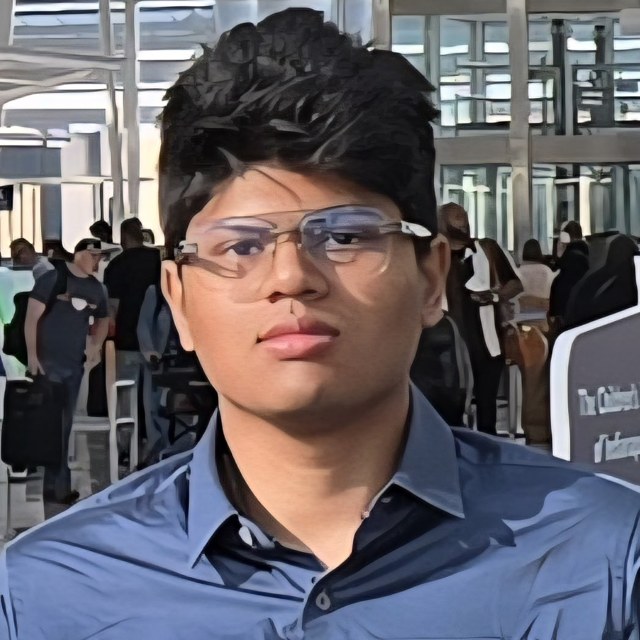
I'm Pradyot. I'm a dual-degree student at Indiana University Bloomington in Computer Engineering and Mathematics (Program II), working toward a PhD in quantitative finance. I do high-performance computing research on IU's BigRed200 cluster, build machine-learning factor models from market data, and study the linear algebra of quantum computing in Prof. Yuxi Hong's lab. The through-line: I like problems that sit exactly where numerical methods, finance, and systems meet, and I like being able to trace every claim back to a run ID. My first paper — on a training-horizon look-ahead trap in LLM-assisted quantum portfolio optimization — was accepted to QNLP-AI 2026 for an oral presentation. Based in Bloomington, IN.
The research journey
How the reading turned into projects, and the projects into a direction. Every project names what it was built on.
- 1Read / learned2025
Linear algebra, properly
Strang, then the proof-heavy version. The realization that eigenstructure, projections, and SVD are the same tools under PCA, factor models, and quantum gates.
- 2Read / learned2025
High Performance Computing (ENGR-E 517, graduate)
Memory hierarchy, parallelism, and the habit of measuring instead of guessing. The course that made me ask what the cache is actually doing.
- 3
- 4Read / learned2026
Empirical asset pricing: Cochrane, Fama-French, Baba-Yara
Discount Rates (2011), Common Risk Factors (1993), and In Search of Sparsity. The factor-zoo problem and why machine learning has to be disciplined by economics.
- 5Read / learned2026
MITx Foundations of Modern Finance + Ruppert
CAPM, APT, and the statistics of financial data — MITx 15.415.1x completed with honors — paired with Ruppert's Statistics and Data Analysis for Financial Engineering for the empirical machinery.
- 6Read / learned2026
ARPM Bootcamp (onsite)
A week of buy-side quantitative methods taken onsite — the ARPM 'Checklist' end to end: estimation, projection, pricing, aggregation, and portfolio/risk construction. The bridge from textbook asset pricing to how it is actually practiced.
- 7
- 8Read / learned2026
Quantum computing: Sutor, Wong, Nielsen-Chuang
Dancing with Qubits and Introduction to Quantum Computing, working toward Nielsen-Chuang. Qubits as unit vectors, gates as unitaries, measurement as the one non-linear step.
- 9
- 10
- 11Shipped2026
Paper: Training Data Set Effects in LLM-Assisted Quantum Portfolio Optimization
Accepted to QNLP-AI 2026 for an oral presentation. Shows that an LLM's apparent portfolio alpha collapses once the model is genuinely out-of-sample — the edge was training-horizon look-ahead, not signal.
- 12Shippednext
Toward a PhD in quantitative finance
A research arc where numerical rigor, modeling depth, and systems thinking all have to coexist — and every claim still traces back to a run ID.
Recent writing
- Building an ethics tool inside the tab people already use
AI Ethics Coach is a Chrome MV3 extension that reviews selected text and returns practical flags without pretending to replace policy or judgment.
- Captain Whiskers: a trading agent that optimizes portfolios with a quantum circuit and signs them with post-quantum crypto
A hackathon build that had no business working: an autonomous on-chain trading agent fusing variational-quantum portfolio optimization, on-chain identity, a risk router, Gemini-driven signals, post-quantum signatures, and an eleven-node Byzantine-fault-tolerant verification layer. Here is the architecture, the math, and which parts were real versus theater.
- Auditing a multi-terabyte filesystem without melting the laptop that audits it
disk-archival-toolkit streams multi-million-row filesystem inventories, classifies storage tiers, and emits budget-aware archival manifests, all in bounded memory. A short note on why the streaming constraint is the whole design, not a detail.
- Making retrieval stop lying: agentic RAG for legal and property diligence
An agentic retrieval-augmented pipeline (LangGraph + Qdrant, served on vLLM, tuned for AMD MI300X) for India real-estate and M&A document review. Most 'AI for legal' demos fail at the same place: the retrieval quietly returns the wrong clause and the model confidently summarizes it. This is how I fought that.
Project gallery
These are the builds I open first when someone asks, "What have you actually shipped?"
qhpc_cache — cache behavior of quantitative-finance kernels
An empirical L1-cache characterization of four numerical-finance kernels (Cholesky, Monte Carlo, GARCH, GEMM) on AMD EPYC, instrumented with PAPI hardware counters on BigRed200. Every claim traces back to a counter measurement, not a vibe.
RegimeFactorZoo — machine-learning factor models with a regime twist
A reproducible Fama-French and ML factor-modeling pipeline built from raw market data. The reconstructed SMB and HML factors now match Kenneth French's published series at ρ ≈ 0.97, so the question it was built for can finally be asked cleanly: do sparse factor selections survive when you split the market by volatility regime, or do they quietly fall apart the moment the VIX moves?
Quantum computing in the Hong Lab
Working through the matrix algebra under qubits, gates, entanglement, and measurement, and where quantum and classical Monte Carlo meet for derivatives pricing. A standing reminder that "linear algebra" and "quantum mechanics" are closer than the course catalog admits.
Captain Whiskers — autonomous on-chain trading agent
A hackathon build: an autonomous trading agent with variational-quantum portfolio optimization, on-chain identity, risk limits, and an eleven-node Byzantine-fault-tolerant verification layer. Yes, the cat has a risk router.
legal-document-intelligence — agentic diligence over messy documents
A retrieval-augmented pipeline (LangGraph + Qdrant, served on vLLM) for property and M&A document review, tuned for AMD MI300X. Built for the unglamorous reality that most "AI" work is making retrieval not lie to you.
About me
I started in visual systems at SCAD, moved into engineering at IU, and added a Mathematics major because I wanted the proof-heavy foundation, not just the applied shortcuts. That combination now points at one goal: a PhD in quantitative finance, working on methods that are measurable, reproducible, and useful outside a backtest.
Day to day, that means three tracks running in parallel: HPC and numerical-methods research, a machine-learning factor-modeling project I can hand to anyone with a laptop and make, and quantum-computing foundations in Prof. Hong's lab. I have also built through messy real-world constraints — a small advertising agency past $10K in revenue, hackathon demos under 48-hour clocks, and research pipelines that force me to show my work.