Research


A cleaner quantum circuit can still give the worse answer
Abstract
I extended an introductory one-qubit example into a controlled simulation study of 4-, 6-, and 8-qubit Ising circuits. The benchmark compares readout correction and linear or quadratic zero-noise extrapolation at 32,768 total shots per protocol, including calibration. It covers 27 circuits, two observables, and 500 synthetic shot replicates per circuit. The main lesson is numerical rather than promotional: reducing error against an ideal digital circuit does not necessarily reduce error against the continuous evolution that circuit approximates.
All observations come from Qiskit Aer using the bundled IBM Kingston calibration snapshot dated April 15, 2026. These are not live-hardware measurements.
1. There are two answers to be wrong about
Let be an observable under exact small-system Hamiltonian evolution, and let be the corresponding ideal product-formula circuit value. A finite-shot estimator has the decomposition
The first term is error relative to the digital circuit; the second is product-formula error. Correcting the first need not reduce their sum. Noise can accidentally cancel part of the discretization error. Remove that noise and the answer can move closer to the circuit target but farther from the Hamiltonian target.
This is not an argument for keeping noise. It is an argument for naming the reference before celebrating the improvement.
2. A fixed budget changes the comparison
The experiment gives each protocol the same number of shots. Readout correction spends some of that budget on calibration; extrapolation divides its remaining shots across CZ-fold factors 1, 3, and 5. Calibration is not free just because it happened before the interesting plot.
An extrapolated estimator has the form
With independent estimates at each noise setting, its variance contains . Large positive and negative weights can therefore erase a bias reduction through increased sampling variability. The benchmark preserves dependence when comparing methods and includes calibration uncertainty in its synthetic trials.
Equal shots also does not mean equal circuit cost. Folded protocols execute more CZ gates. The write-up reports this distinction rather than calling the comparison an equal-compute experiment.
3. The result that stayed in the report
Quadratic extrapolation performed worse than the linear combined method in 38 of 54 case-observable comparisons. That is a result for this fixed benchmark, not a universal ranking of mitigation methods.
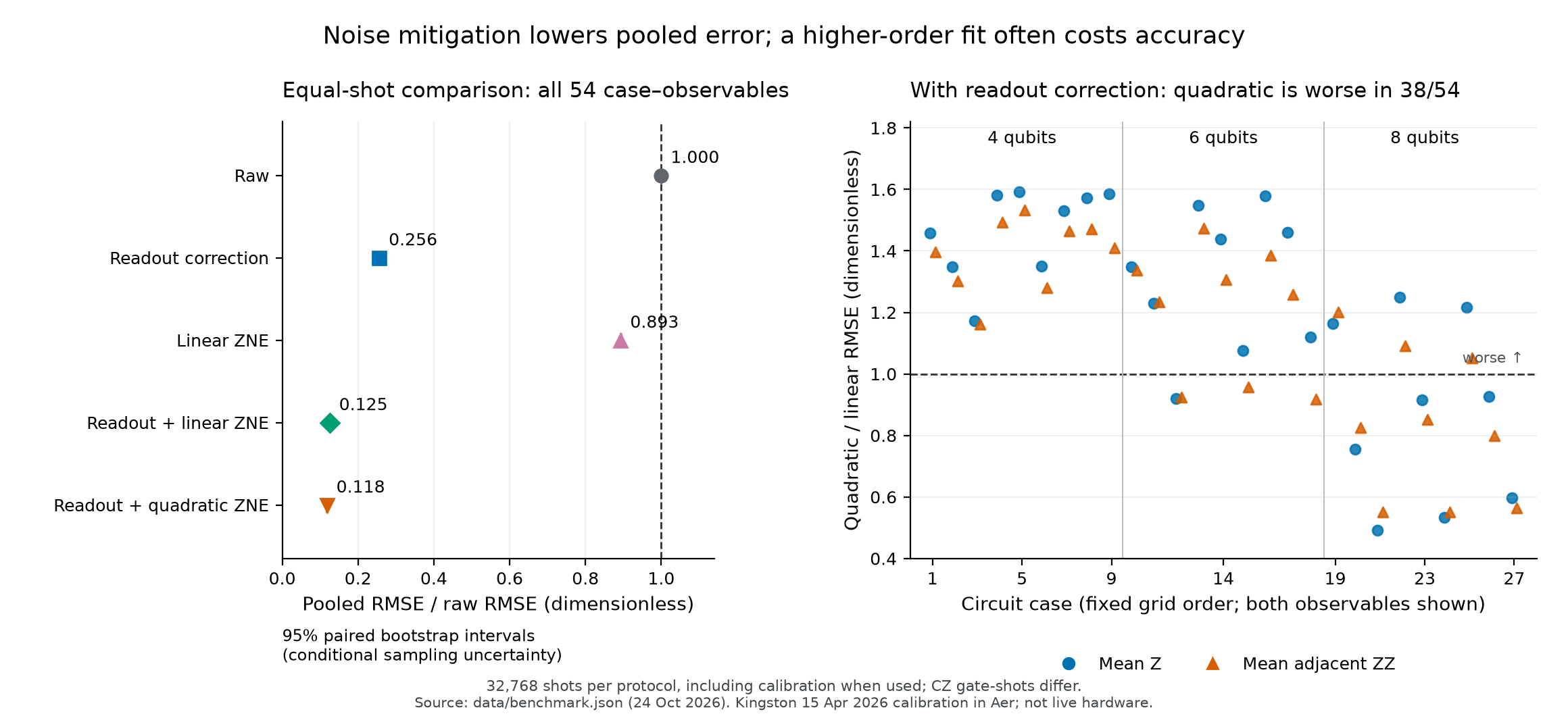
Figure generated from the study's saved simulation results. All comparison rows are available, including cases where a correction performs poorly.
The protocol does not select successful circuits or fit orders after seeing the outcomes. The quadratic fit also has zero residual degrees of freedom at three noise settings: passing through three points is not independent evidence that the extrapolation is reliable.
4. What the benchmark does not establish
The channel model omits effects including drift, leakage, crosstalk, and correlated readout. The selected physical path shares a substantial asymmetric-readout condition across the cases. Sampling intervals are conditional on that model; they do not include uncertainty about whether the model describes the real device.
This work evaluates established mitigation ideas. It is not quantum error correction, a hardware benchmark, or a demonstration of quantum advantage. The useful output is a reproducible numerical example where bias, variance, and discretization can be inspected separately.
Reproduce and inspect
The public package contains the write-up, figures, protocol, environments, and tests. Its verification records describe 18 multi-qubit tests plus the earlier 20 introductory tests. The simulator and statistical-analysis environments are pinned separately because package versions can change random sampling streams.
This is the direction my earlier quantum foundations work led: less time saying that noise is bad, more time specifying which error I am measuring.
References
- Temme, K., Bravyi, S., and Gambetta, J. M. (2017). Error Mitigation for Short-Depth Quantum Circuits. Physical Review Letters, 119, 180509.
- Benchmark methods and limitations.
- Three-page study write-up.